1.Cultural Craft India: 7 Stunning Secrets of Traditional Pottery
The true essence of cultural craft india begins with the earth beneath our feet. India is a land deeply woven with diverse, ancient traditions, where every region tells its own unique, breathtaking story through its art. When we explore the magnificent world of heritage handicrafts, we are taking a journey through time. From the intricate weave of a handloom textile to the earthy, grounding presence of handmade clay decor, these physical treasures are far more than mere decorative items. They are the enduring manifestations of centuries of history, local beliefs, and the irreplaceable human touch.
At Culture Feel Craft, there is a profound understanding that art is not just manufactured; it is born. The traditional crafts of the subcontinent represent a vital lifeline to our past, offering a rich narrative that continues to thrive in the modern era.
2.The Heart of Cultural Craft India: Pottery Thrown by Hand
Pottery is arguably one of the most ancient and grounding forms of creative expression known to humanity. In the realm of Indian traditions, working with clay is considered an almost sacred practice. It is, quite simply, cultural craft india, thrown by hand.
When you hold a piece of authentic handcrafted pottery, you are holding a memory. As the ancient philosophy dictates, every pot remembers the hands that turned it. Unlike factory-produced, uniform ceramics devoid of character, traditional pottery carries the subtle, beautiful imperfections of its maker. The pressure of the artisan’s fingers, the speed of the wheel, and the rhythm of their breathing are all permanently recorded in the curvature of the clay. This deep connection between the creator and the creation is what gives handmade pottery its unique soul.
3.7 Stunning Secrets of Cultural Craft India
If you want to truly appreciate the depth of this heritage, it helps to understand the incredible processes and secrets hidden within the clay:
1. The Alchemy of the Kiln
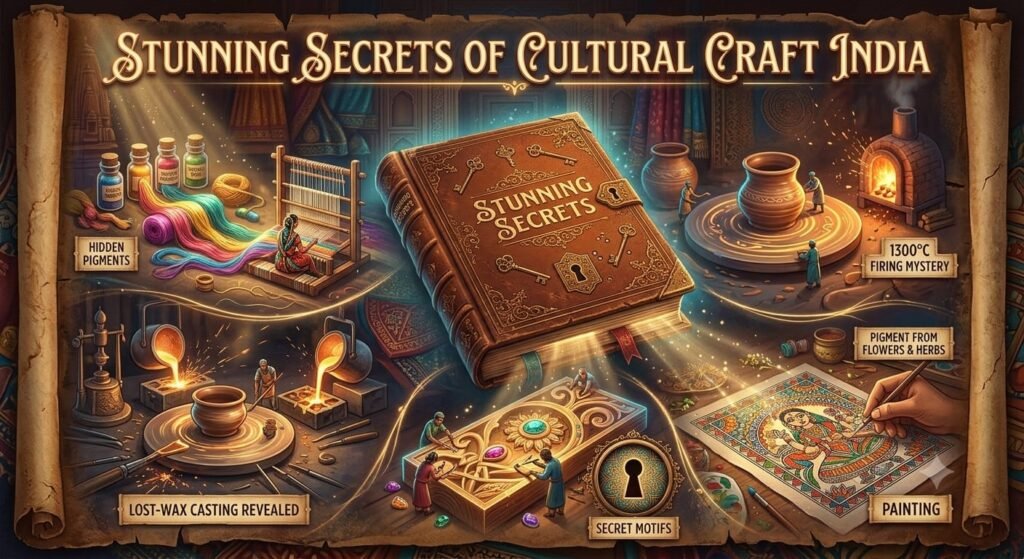
The creation of traditional pottery is an elemental alchemy combining earth, water, air, and fire. Master artisans utilize distinct clay traditions and highly precise, time-tested firing techniques. Depending on the region, these clay pieces are baked in the kiln for 1 hour at a time, reaching intense temperatures that range strictly between 900°C to 1300°C. This intense heat transforms the soft mud into a durable, timeless vessel.
2. Celebrating the Source: The Soul of Cultural Craft India
In the authentic world of cultural craft india, the approach to finishing a piece is deeply philosophical. You don’t decorate a pot to hide the clay. You decorate it to tell you where the clay came from. The glazes, the etchings, and the raw textures left exposed are deliberate choices meant to honor the earth.
3. Six Traditions, One Wheel
Across the Indian subcontinent, the potter’s wheel serves as the great unifier. While there are countless regional styles—from Raku to Bizen-inspired firing techniques—they all rely on the steady, rhythmic spin of the traditional wheel, proving that diverse cultures can share a single, beautiful foundation.
4. The Lost Wax Technique
Beyond clay, metalwork forms a massive pillar of Indian heritage. The ancient Dhokra casting method has been in continuous use for over 4,000 years. Artisans sculpt a clay core, cover it in wax, and then encase it in more clay before pouring molten metal to replace the wax, resulting in stunning, one-of-a-kind artifacts. You can read more about the history of Indian pottery and casting to see how deep these roots go.
5. Sustainable Artistry
Long before the modern world embraced eco-friendly practices, Indian artisans were masters of sustainability. Every material—from the mud gathered at local riverbanks to the natural dyes extracted from turmeric and indigo—is sourced responsibly and returned to the earth without harm.
6. Generational Knowledge
The most stunning secret is not a technique, but a lineage. The intricate skills required to perfectly fire clay at 1300°C are rarely learned in a classroom. They are passed down verbally and physically from parent to child over generations, preserving a continuous, unbroken chain of knowledge.
7. Modern Adaptability
These ancient techniques are not stuck in the past. Today, masterful artisans are adapting traditional aesthetics for modern spaces. From sleek, minimalist black pottery to richly textured clay home decor, these crafts fit seamlessly into contemporary interior design.
4.Exploring Cultural Craft India Through Local Heritage
The landscape of regional handicrafts includes highly specialized pottery styles that have evolved organically over millennia. Different communities developed unique methods based on their local resources. For instance, Longpi pottery from Manipur uses a mixture of hard serpentine rock and local clay to hand-shape vessels known for their incredible durability and minimalist beauty, crafted entirely without a wheel. Meanwhile, the Khavda potters of Kutch utilize mud sourced directly from local lakebeds, adorned with natural earth colors.
When you browse our handmade collections to find the perfect piece for your home, you are doing more than decorating a room. You are supporting sustainable livelihoods and keeping hand-crafted narratives alive. Pair a statement piece with our handloom textile range or explore more clay home decor for a complete, grounded interior.
In an era increasingly dominated by mechanized, soulless mass production, investing in cultural craft india ensures that the rich, textured story of the world’s greatest artisans continues to be told for generations to come. By appreciating the art of the wheel, we preserve the very heartbeat of history.tions to come.